Video platform · primary workflow
YouTube — copyright enforcement
YouTube is a primary focus among the supported copyright workflows. The requirements of this reporting route are publicly documented. Common failure modes can include insufficient identification of the work, imprecise locations, or authority to act that is not adequately documented.
Context
Video re-uploads are rarely clean. Clips get mirrored, the audio is replaced, the speed is nudged, the material is buried inside a longer video. None of that changes the principle: the notice has to state which part of which protected work appears at which point of the reported video. We prepare exactly that mapping before anything is filed.
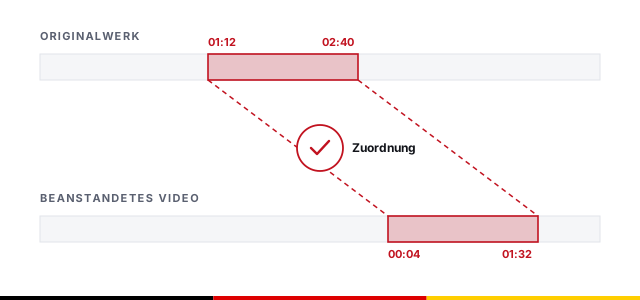
What a YouTube notice has to carry
These are the load-bearing items. Miss one and the notice is open to challenge, however obvious the case looks.
- Original work
- Title, type and version of the protected work, plus the internal work reference it is held under here.
- First publication
- Where and when the work was lawfully published, as far as it can be evidenced — usually a link to your own publication.
- Copyright owner
- Who actually holds the rights in the work. That is never automatically the agency filing the notice.
- Authorization
- A documented Letter of Authorization that exists before submission and covers this specific matter.
- Reported URL
- The full video URL. A channel name or a search result is not enough.
- Uploader / channel
- The channel identifier, as far as it is needed for the mapping.
- Timestamps
- Start and end of the copied ranges, both in the original work and in the reported video.
- Mapping
- Which section of the work recurs where — matching, not "thematically similar".
- Personal signature
- The full legal first and last name of the authorized individual. A company name does not substitute for a required personal signature.
These items are prepared in full before submission. If something is missing, the matter is returned rather than filed.
How a YouTube case runs
Record the work
The original work is documented and given a work reference that every later reported use is attached to.
Collect reported uses
Each reported video URL is recorded individually. Several uses of the same work remain several uses.
Prepare the mapping
For each reported use, the copied range is mapped onto the original work with timestamps.
Check the authorization
We check that a valid authorization covers the work, the platform and the period. Without it nothing is filed.
Human release
A person reviews the case and releases it. There is no automated bulk filing.
File as authorized representative
The notice goes through the platform’s official reporting path, stating the representative relationship.
Answer follow-up requests
If the platform asks for more information, that is tracked as its own case state and answered.
Record the outcome
The actual outcome is recorded — including "rejected" and including "was already unavailable".
Possible outcomes
The outcome is recorded with the actual case status — including when it is unfavourable.
- RemovedREMOVED
- Already unavailableALREADY_UNAVAILABLE
- RejectedREJECTED
- Need more informationNEED_MORE_INFORMATION
- Counter-notification receivedCOUNTER_NOTIFICATION_RECEIVED
Counter-notification
The other side can dispute a notice. That is a designed step in the process, not a malfunction. When a dispute arrives, we examine its reasoning on the merits.
If it holds, we do not pursue the matter further and record that. If it does not, we discuss the next steps with the client — noting that from this point the available routes routinely lie outside what an agency can and may do.
In our records a counter-notification does not overwrite the original outcome. Both states are kept separately because they answer different questions.
Repeat infringement
The same work often reappears after a removal, sometimes from the same quarter. We keep those matters under the same work reference so the pattern can be evidenced over time, instead of treating every notice as an isolated event.
- Reported uploads
- Number of individual uploads notices referred to.
- Reported uses
- Number of reported locations. Several locations of the same work count more than once.
- Unique works
- Number of protected works involved. A work counts once, however often it was copied.
What we do not claim about YouTube
- No promise that a video will be removed — the platform decides.
- No processing time we do not control.
- No partnership, no trusted-flagger status, no privileged access.
- No statement about Content ID claims beyond the scope of the engagement.
- No notice against an entire channel when only individual videos are affected.
Independence
DMCA Agency Deutschland is an independent copyright-enforcement service provider. It has no connection to United States Copyright Office, YouTube, Google, Meta or TikTok, and no relationship with any public authority. Platform names are used solely to identify the services in question; no partnership or endorsement is implied.
Have a case on this route assessed
You describe the matter; we set out which reporting route comes into consideration and what is still missing. Non-binding. copyright@dmcaagency.de